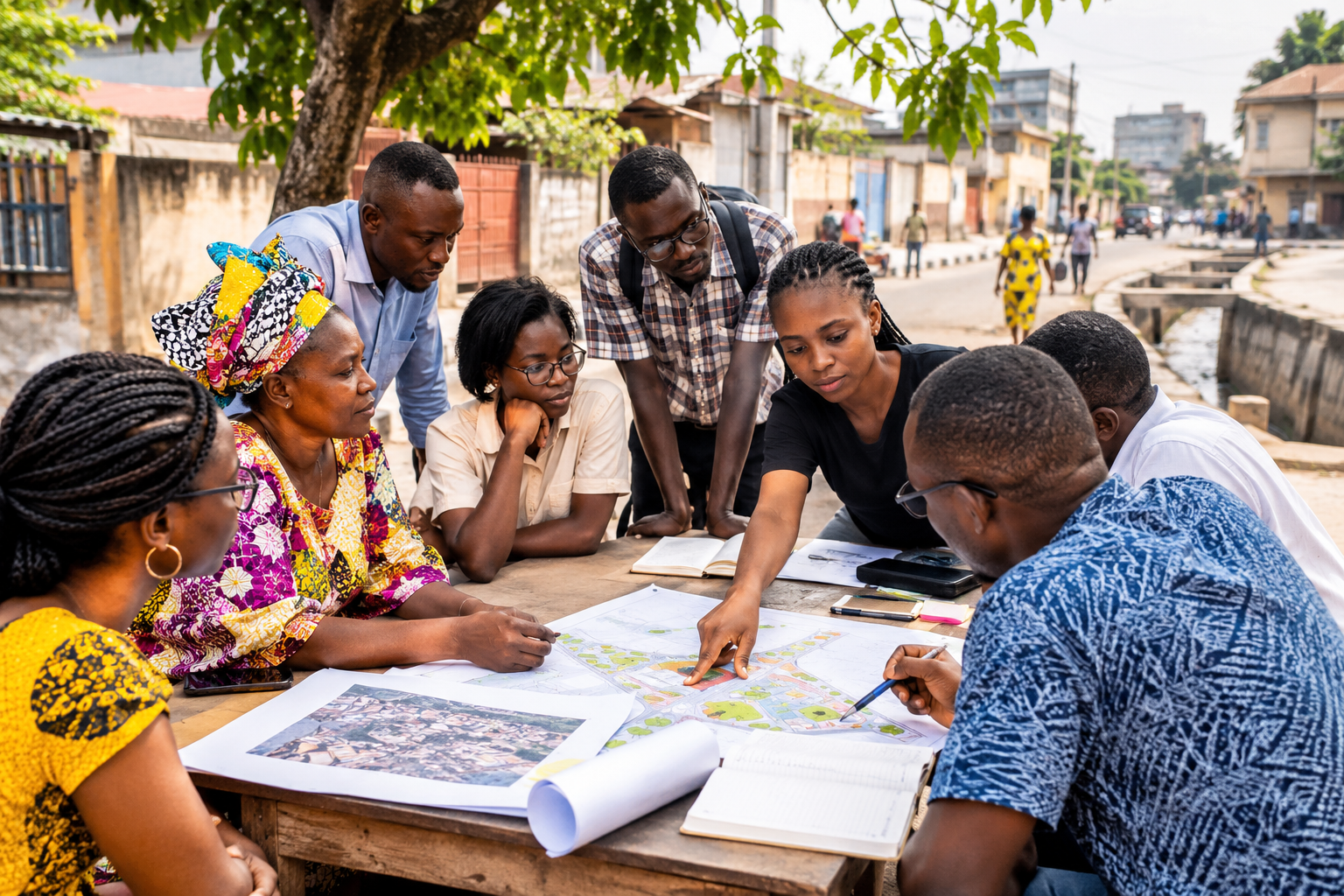
In Kinshasa, rethinking urban planning education through local initiatives and entrepreneurship to support more inclusive and sustainable urban development.
This ARES Training Project for the Global South aims to renew urban planning education at the Higher Institute of Architecture and Urban Planning (ISAU) in Kinshasa. Field-based workshops lie at the heart of the curriculum: students, teachers and local stakeholders examine urban change together and support community-led initiatives. The programme combines urban planning, social sciences, entrepreneurship and management. Through Laurent Lahaye, ICHEC contributes to entrepreneurial skills development and reflection on urban planners’ business models. Two doctoral research projects explore the role of local initiatives and the evolving profession of urban planning.
Context
Rapid urbanisation in the Democratic Republic of the Congo brings major challenges, including access to services, mobility, erosion, deforestation and environmental inequalities. Conventional planning tools struggle to reflect realities on the ground, where residents, associations and entrepreneurs are already developing solutions. As higher education transitions to the bachelor–master–doctorate (LMD) system, ISAU in Kinshasa seeks to adapt its curriculum to better understand these local dynamics and train urban planners who can work with communities.
Needs addressed
Future urban planners need skills that reflect how cities are actually shaped, beyond regulatory planning alone. The project meets this need by connecting teaching, research and fieldwork. It also aims to strengthen the capacities of practitioners and community leaders and support collective initiatives that sustainably improve residents’ living environments.
Expected results
Expected results include a renewed urban planning curriculum at ISAU, built around field-based action-learning workshops and an interdisciplinary, entrepreneurial approach; two doctoral theses on entrepreneurial initiatives in urban development and the changing role of urban planners; continuing education modules for professionals; stronger support for community leaders; and the sharing of lessons learned through local feedback sessions, an academic conference, a symposium and publications. The overall aim is to strengthen urban planners’ contribution to territorial governance and improved living conditions.
Financing
ARES